Facades made of timber frame construction
How Prefabricated Building Envelopes Set New Standards in Quality, Speed, and Design
Facades are no longer just an exterior cladding. They are a highly complex component of modern buildings – technically, aesthetically, ecologically, and significantly relevant in the construction process. With prefabricated timber frame facades, Rubner develops solutions that integrate all these requirements: precise, customized, and above all, reliably planable.
The idea behind this is simple: facades and building envelopes should inspire, protect, save energy, and simplify processes. They should provide architects and builders with maximum freedom. This is where the strength of timber frame construction begins.
Individual Facade Planning and Integrated Project Coordination
Individual Facade Planning and Integrated Project Coordination
Every facade project at Rubner starts with intensive coordination. No building envelope is the same. Architecture, usage, technical requirements, and energy goals all work together.
A technical manager aptly describes this process:
“Communication in advance is extremely important. Only when all parties have the same understanding and can identify potential problem areas early on do the processes run smoothly later.”

This early, collaborative phase is crucial for ensuring that our facades not only look good but also perform precisely as intended. Projects like Variowohnen in Bochum demonstrate that even extraordinary architectural approaches can be realized, where different surfaces, complex building services integration, and a very high degree of prefabrication merge into a first-class building envelope.
Prefabrication: Precision You Can See and Feel On-Site
The quality of a facade in timber frame construction is determined not only on the construction site. It is created in our factories, where the elements are manufactured under ideal conditions: dry, weather-independent, and highly automated.
“The simpler the timber construction work appears on the construction site, the more sophisticated the planning and prefabrication were.”
– Technical Management Rubner
This precision later manifests throughout the entire process: quick assembly, reliable workflows, and high cost transparency. In projects like the Campus Osmose in Dijon, where approximately 3,800 m² of facade area was completely manufactured off-site and installed in a very short time, this led to an exceptionally smooth and efficient construction process.
Design Freedom Without Compromises
Timber frame construction is not just about a wooden appearance. On the contrary: the architectural possibilities today are nearly limitless.
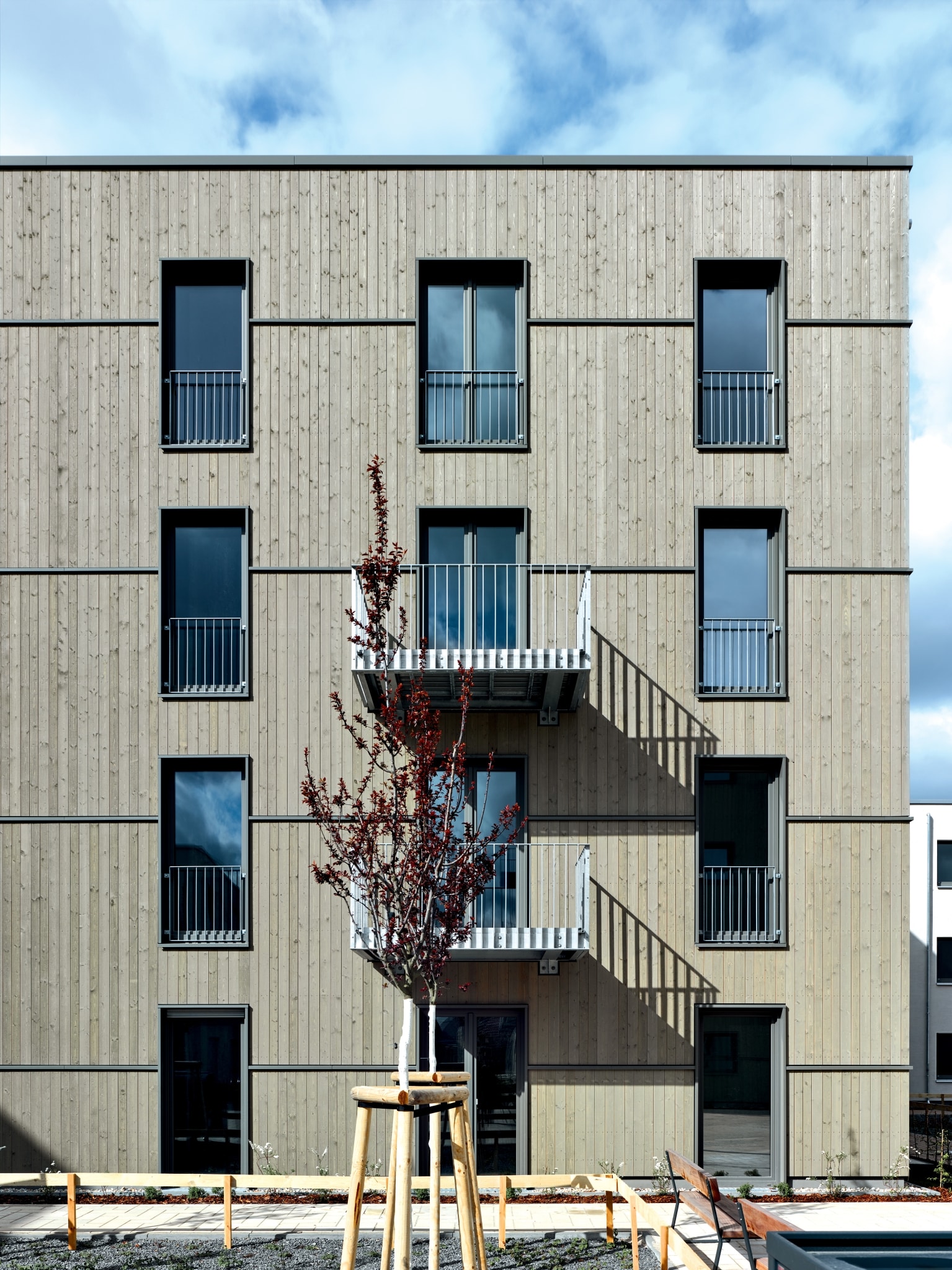
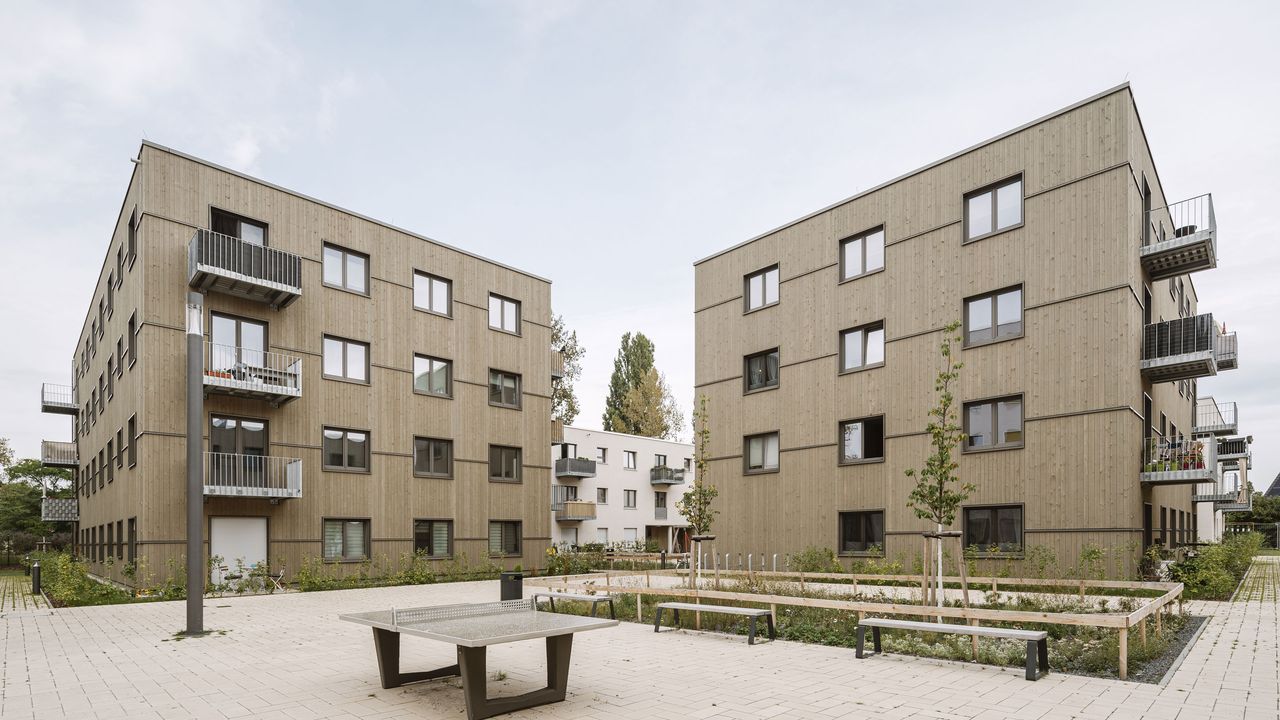
Whether it’s wooden cladding, fiber concrete, finely structured panels, large-format window bands, or post-and-beam constructions, the elements can be combined with a variety of surfaces and technical components – integrated in the factory, neatly detailed, and perfectly coordinated.
For example, at the Overnight shelter, the facade was constructed as cross-story elements, including a complex fire compartmentation concept. The outer appearance is delicate and lightweight, while the underlying structure meets the highest standards.
Technology That Is Already Considered in the Facade
Rubner’s timber frame facades are not just “envelopes,” but functional components: they integrate sun protection, ventilation, electrical systems, windows, and sometimes even complete post-and-beam units directly in the factory.
This significantly reduces the number of on-site work steps and ensures consistently high quality that requires minimal adjustments during construction.
A technical manager puts it this way:
“Large buildings place high demands on the scheduling and quantitative capabilities of timber construction. Our building envelopes demonstrate how all trades can work together seamlessly.”




Sustainability that not only feels good—but has measurable impact.
Wood from certified forestry, bio-based materials, minimal construction waste, and high energy efficiency:
The ecological advantages of timber frame facades are diverse and have become measurable in projects such as Bagneux near Paris, where a former industrial building was transformed into an energy-efficient health and residential complex.
Additionally, our facades meet the requirements of various environmental labels— making it easier for builders to significantly improve the CO₂ balance of their buildings.
Fire Protection with a System
Wood and fire protection? It works well – if planned correctly.
Our facade systems feature tested and validated structures, and particularly in projects with high requirements, such as UTN Nürnberg or SAF Johannisgärten Berlin, significant advantages become apparent:
Elemented facades with clearly defined fire protection layers, beams, and compartment walls that are manufactured under controlled conditions in the factory achieve a very high level of execution reliability and planability.
Conclusion: When Technology, Planning, and Architecture Come Together
Facades made of timber frame construction are a powerful tool for modern architecture – and a benefit for planners and builders who value quality, sustainability, and reliable processes.
They offer:
- Impressive architectural freedom
- Precise prefabrication and high speed
- Excellent thermal and ecological performance
- Verified fire protection
- Technical integration that significantly simplifies processes
Rubner supports this journey from the initial idea to the completed building envelope – through intensive collaboration, technical expertise, and a commitment to developing each facade as uniquely as the building requires.
Interested?
Rubner accompanies this process from the initial idea to the construction of the building envelope, through an intense exchange of ideas, with technical expertise and the aim of developing each façade in a personalised way, based on the needs of the building.