Reaching New Heights with Timber
Multi-Story Timber Construction: Customized, Efficient, Experienced.
Cities are becoming denser, space is becoming scarcer and the demands placed on buildings are increasing. Housing, educational buildings and modern workplaces must be created within limited space, and must be efficient, sustainable and architecturally compelling.
Timber construction opens up new possibilities for this. It is particularly in an urban context that the capabilities of this construction method are evident today. Precisely planned, industrially prefabricated and efficiently implemented.
However, building in the city also means dealing with complex conditions. Narrow plots, limited storage space, short construction times and a high need for coordination demand clearly structured processes. This is precisely where the strength of timber construction lies, when materials, planning and workflow are considered together from the beginning.
What sets timber construction apart in urban areas
In an urban context, it is not just about the structural framework, but about the interplay of all project factors.
Thanks to its high degree of prefabrication, timber enables precise and predictable implementation. Components are manufactured under controlled conditions and delivered to the site ready for assembly. This reduces construction times, creates clarity in the workflow and minimises disruption to the surrounding area.
At the same time, this construction method allows for slender structures low self-weight.. This offers advantages for infill development, building extensions or projects involving existing buildings – wherever space and load-bearing capacity are limited.
Technical requirements in an urban context
Urban construction places high demands on planning and implementation. Plots are often narrow, access routes restricted and assembly areas limited. This results in clear requirements regarding component sizes, logistics and construction processes.
Added to this are issues such as fire safety, sound insulation and building physics. These must be considered jointly at an early stage, as they have a direct impact on the structure and execution.
A structured planning process is therefore crucial, particularly where prefabrication and assembly are closely interlinked.
Planning and implementation
The quality of a project is established in the early stages. Our experience shows how important it is to consider the logic of timber construction from the beginning.
Site, transport routes, crane positions and assembly sequences define the framework conditions. Based on this, the structural framework, building physics and execution are coordinated.
The clearer the processes, the more efficiently and safely a project can be realised, particularly in urban areas with their restrictive constraints.
Cost-effectiveness in the project context
Timber construction is cost-effective in urban areas when the entire process is taken into account.
Short construction times, predictable workflows and reduced disruption on site can bring clear advantages. This is particularly true for projects with complex constraints or in existing buildings.
This requires an early decision on the system and consistent planning. This results in solutions that are convincing not only technically but also economically.
Typical risks in urban projects
Many challenges in urban timber construction do not stem from the material itself, but from the way projects are conceived and structured.
A common issue is the late inclusion of timber construction in the planning process. If the system is only finalised after fundamental decisions regarding geometry, structure or construction sequence have already been made, many advantages can no longer be fully exploited.
Equally critical is the isolated consideration of individual requirements. Structural systems, fire protection, sound insulation and logistics must be considered together from the beginning. Particularly in an urban context, separate approaches quickly lead to contradictions in execution.
Another crucial factor is site logistics. Narrow access routes, limited storage space and challenging installation conditions are often viewed too broadly in the early project phases. During implementation, however, these factors have a direct impact on processes, costs and deadlines.
In practice, similar patterns repeatedly emerge:
- system decisions made too late
- lack of integrated planning
- underestimated site logistics
- unclear interfaces
- overly general assumptions about the project workflow
This is precisely why it is crucial to approach urban timber construction projects not only from a structural perspective, but always from a process-oriented one as well.
FAQ´s
Yes. Due to its low weight, timber is particularly well suited for extensions to existing buildings.
Prefabrication ensures high quality, predictable processes and shorter construction times. This is a major advantage, particularly in an urban context.
Not necessarily. Prefabrication and faster construction times can lead to cost-saving benefits, particularly when considering the project as a whole.
Yes. Modern timber structures meet all fire safety requirements and are designed and tested accordingly.
Yes. Multi-storey timber construction is now state of the art and is being successfully implemented in various types of buildings.
Particularly for projects with limited space, short construction times or complex site logistics. Timber enables precise planning and efficient processes.
Challenging Project?
We Speak the Same Language.
Multistory timber construction requires experience. The higher the building, the greater the demands: on statics, assembly, logistics, and planning.
That’s why we think integratively: We support architects and planners from the very beginning. We consider transport routes, assembly sequences, interface reduction, and scheduling. We know that every detail counts, especially in urban situations with limited storage space, high traffic, and tight schedules.
Those who involve us early benefit from well-designed processes, optimized interfaces, and significantly more planning security. In demanding projects, it becomes clear that proactive planning determines success.
Our range of services extends from comprehensive consulting and engineering services, as well as detail development during the planning phase, to product-specific production and assembly planning, along with cross-trade coordination on the construction site. Thanks to our production capacity of over 250,000 m² of roof, ceiling, and wall elements annually and stringent quality assurance through industrial prefabrication, we can reliably, efficiently, and punctually implement large and complex construction volumes.
This is not an add-on – it is a central success factor. Timber construction is most effective when the material’s inherent qualities are taken into account from the outset. This results in solutions that are not only technically sound but also visually compelling.
Projects That Showcase the Potential of Wood
Our references demonstrate the versatility and performance of multi-story timber construction today, across various scales, building tasks, and urban contexts.
ROOTS in Hamburg: Germany’s tallest wooden building at 72 meters, featuring 20 stories, 16 of which are constructed from timber. The load-bearing interior walls, ceilings, and façade elements made from over 5,500 m³ of wood were prefabricated in large formats and precisely assembled on-site. A second glass façade permanently protects the wooden structure – a strong example of technical precision in urban construction.


Waldcampus Aalen: This six-story campus combines a highly efficient wood load-bearing structure with timber-concrete composite ceilings and exhibits a clear architectural stance. Reduced construction moisture, quick assembly, and high quality of life make this project a model for functional educational buildings.


Cube One at the Technical University of Nuremberg: A multi-story timber building constructed around reinforced concrete cores, incorporating around 1,500 m³ of wood in prefabricated ceiling, roof, and wall elements. The flexible room concept is designed for future research and teaching needs. Two green facades and a PV system underscore the holistic sustainable approach.


Residential Complex Ober-Grafendorf: This project in Lower Austria demonstrates how affordable housing can align with architectural quality: four modular timber buildings were docked to an L-shaped concrete core, complemented by prefabricated façade elements with integrated insulation, windows, and wooden cladding.
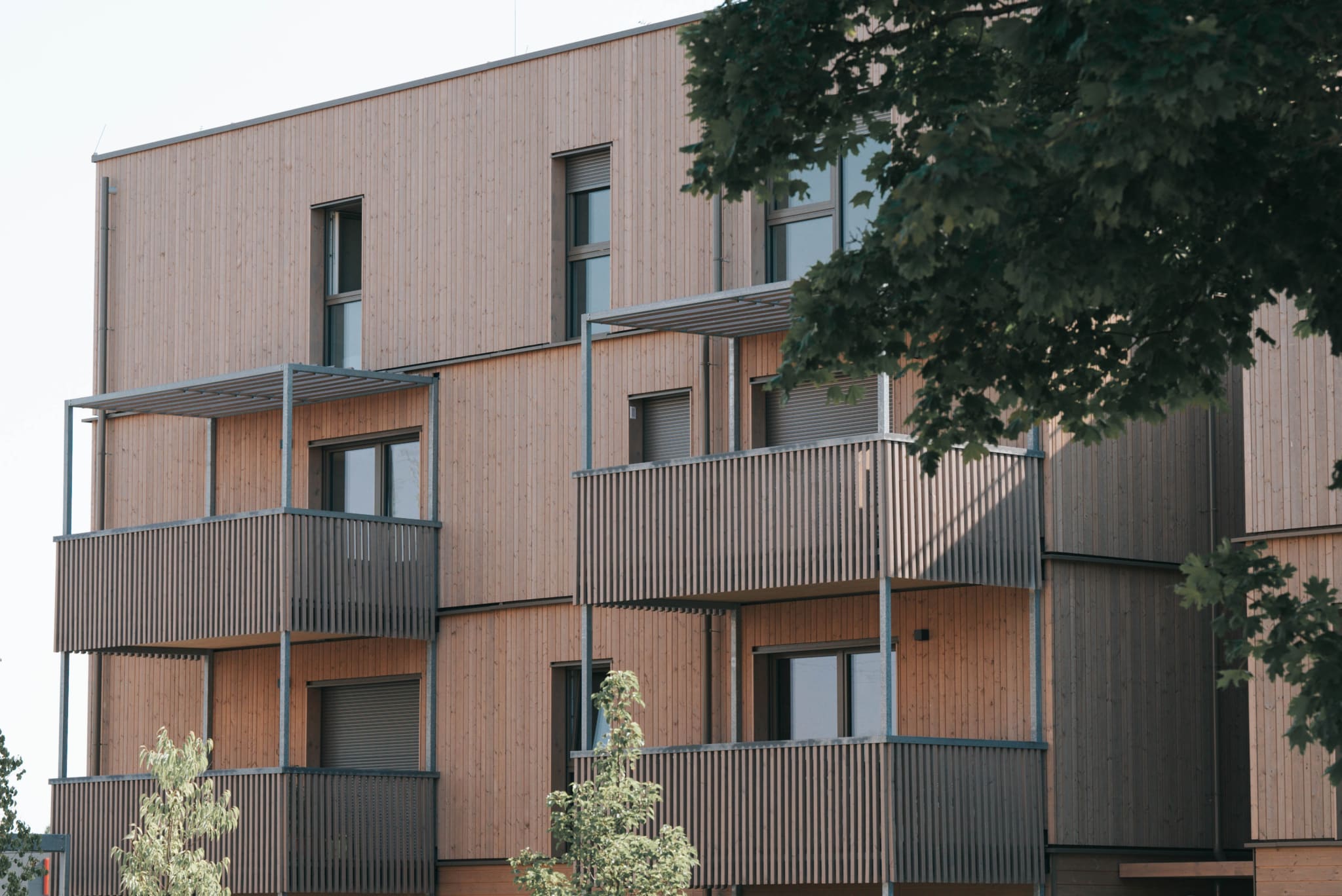

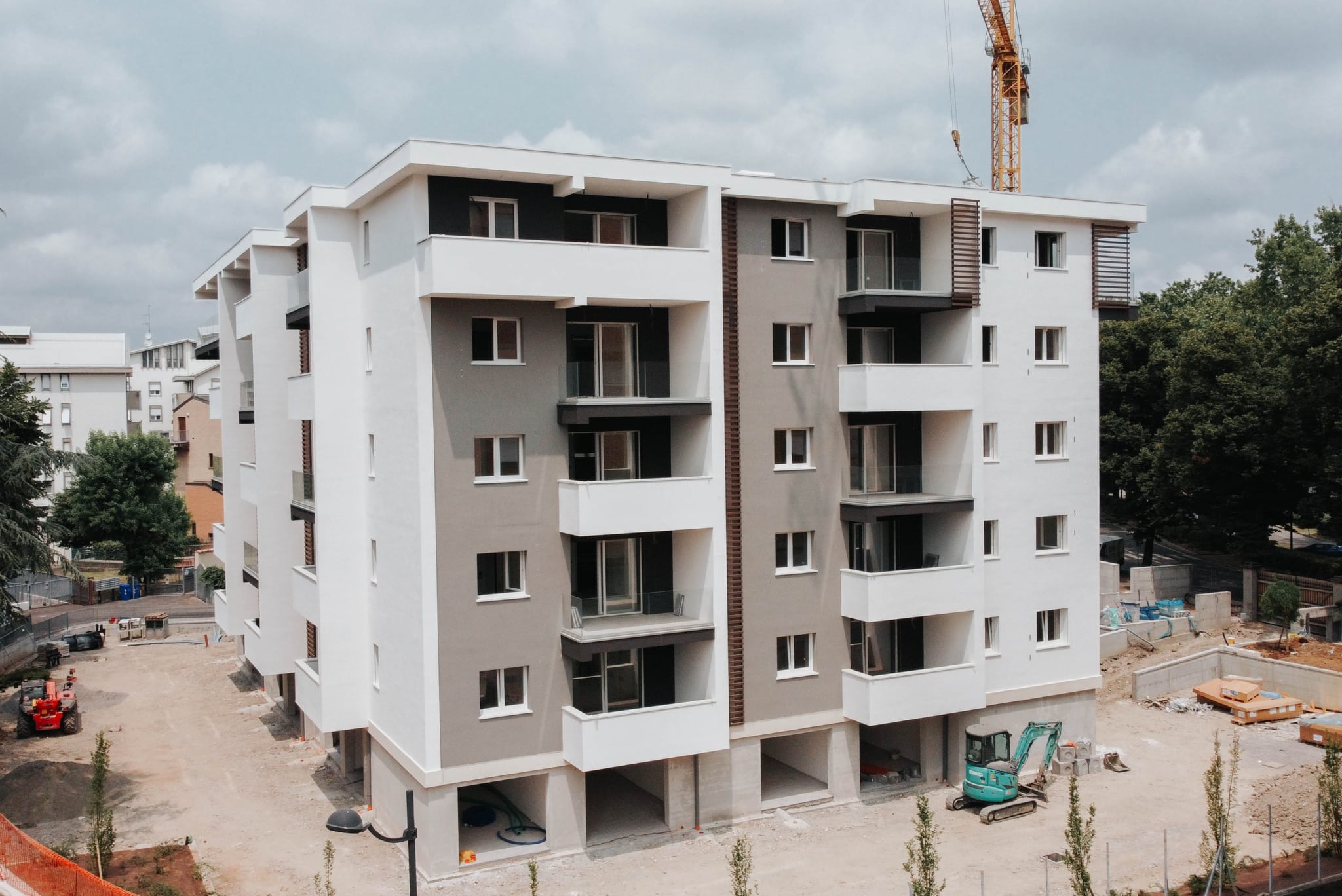
Residenza Emilia in Parma: Originally planned conventionally, this project was entirely realized in timber construction, with five above-ground stories and 50 residential units. The load-bearing structure made from cross-laminated timber (CLT) was assembled in just six months, including complex technical details like balcony insulation and glass railings.

New G in Paris: A forward-looking ensemble of three buildings with a total of twelve stories. The load-bearing structure consists of laminated timber, complemented by timber-concrete composite ceilings and an integrated timber frame facade. Communal areas such as a rooftop cinema, sports hall, and library promote social interaction – a bold step towards sustainable urban design.


Where the future takes shape
Multi-storey timber construction plays to its strengths where other building methods reach their limits:in established urban structures, in infill development or in confined spaces.
At the same time, the construction method is constantly evolving. Modular approaches, serial processes and new concepts for circular construction are gaining in importance.
This is not just about technology, but also about how we envision the future of our cities.